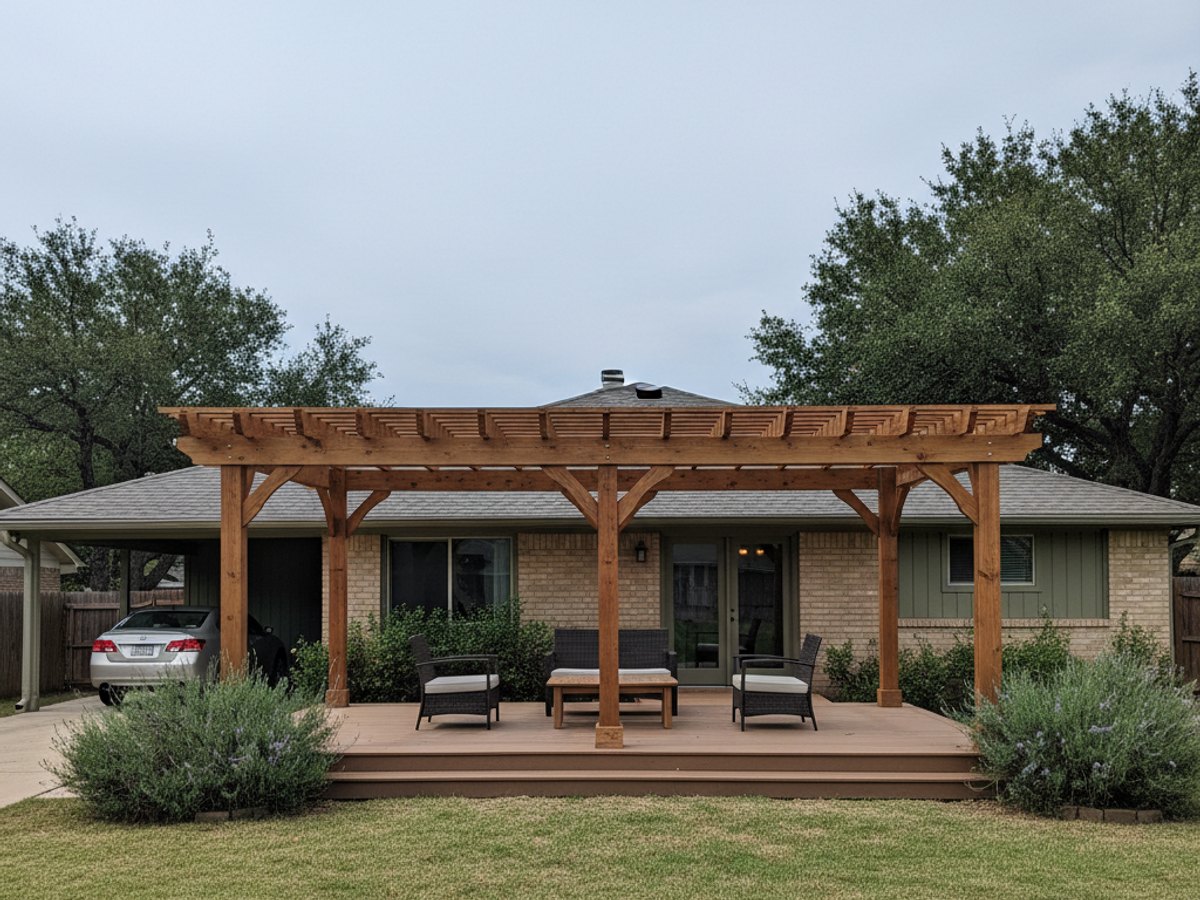
Most deck problems don't show up on day one. They show up eighteen months later when a footing heaves, a ledger board starts to pull, or the boards cup after their first monsoon season. A little bit of checking before the first post hole gets dug saves you from a lot of that. Here's what actually matters in this part of Texas.
What's under the dirt
El Paso soil is not uniform, but a lot of lots here sit on caliche, a hardpan layer of calcium carbonate that can start anywhere from a few inches to a couple feet down. It's basically rock. A standard post hole digger won't touch it, and a lot of crews find out the hard way mid-dig that they need an auger bit or a jackhammer. Before you commit to a footing layout, it's worth knowing whether you're digging into sandy loam the whole way down or hitting caliche at 14 inches.
Footing depth matters too. Most deck footings here need to go at least 12 to 18 inches below grade, both for frost and for bearing capacity, and if caliche sits right at that depth you may need a wider footing instead of a deeper one. This isn't something to guess at. It's a code question and a soil question at the same time.
What the sun and heat actually do to the material
El Paso runs close to 300 sunny days a year, and at 3,700 feet of elevation the UV is stronger than most people expect. Pressure-treated pine that isn't sealed within the first few months will start checking and splitting from sun exposure alone, not just moisture. If you're set on wood, plan on staining or sealing it early, not waiting a full season like some guides suggest for other climates.
Composite decking handles UV better than wood, but dark colors get hot. Surface temperatures on a dark brown composite board in July, with highs sitting at 100 degrees or better, can get too hot to stand on barefoot by early afternoon. If you've got kids or a dog that uses the deck all day, a lighter composite color or a wood-tone blend is worth thinking through before you buy, not after.
Gaps between composite boards matter here too. Composite expands and contracts with heat more than people expect. A 1/8 to 3/16 inch gap between boards isn't cosmetic, it's what keeps the deck from buckling when the surface hits 140 degrees in direct sun.
Water, grading, and the few weeks that matter
El Paso is dry most of the year, which makes people forget about water until monsoon season hits in July and August. Those storms don't drizzle. They dump an inch of rain in 30 minutes and then stop. If your lot doesn't shed water away from the house, that water finds the lowest point fast, and if the lowest point is under your new deck, you'll know it by August.
Check the grading before anything gets built. Ledger board flashing matters even in a dry climate, maybe more, because the house only has to deal with real rain a handful of weeks a year and isn't built with the same margin for error as a house in a wetter state. A deck built flush against an unflashed ledger will eventually let water behind the siding, even here.
Permits, setbacks, and whether an HOA has a say
The City of El Paso's Development Services handles permits for most residential deck work, and if the deck is attached to the house or sits above a certain height off grade, it almost always needs one. Inspections typically happen at two points: after the footings are dug and before concrete goes in, and again once the framing is up but before the decking boards cover it. Skipping that first inspection is the single most common reason people end up tearing out concrete later.
If you're in unincorporated El Paso County rather than city limits, the process runs through the county instead, and setback rules can be different. Either way, a quick check of your property line and setback requirements before you design the deck beats finding out after it's built that it's six inches into a side yard easement.
HOAs are common in a lot of the newer subdivisions on the east side, places like Horizon City, Socorro, and parts of far east El Paso built in the 2000s and later. Older, more central neighborhoods, Kern Place, Sunset Heights, Five Points, mostly don't have one. If you've got an HOA, check their design rules before you fall in love with a railing style or a stain color. Some restrict height, material, or even whether a pergola counts as a separate structure.
What your actual house will let you do
Older El Paso homes, especially the brick houses built from the 1920s through the 1950s in the central neighborhoods, often have solid lumber framing or block construction that doesn't always take a standard ledger attachment the way newer framing does. If the rim joist isn't where you expect it, or the wall is masonry instead of wood frame, a ledger-attached deck may not be the right call at all, and a free-standing deck with its own posts might be the better fix.
Newer subdivisions built from the 2000s on, especially further east toward Horizon City, usually have engineered rim boards and standard framing that take a ledger connection without much trouble. That's a different job than retrofitting an older house, and it's worth knowing which one you've got before a contractor quotes the work.
One more thing worth checking: spring winds. El Paso gets strong, sustained wind in March and April, sometimes with dust storms that rattle anything not fastened down well. Railing posts and pergola anchors need to be rated for that, not just set in a bag of quick-set concrete and left to hope.
None of this is complicated once you know to look for it, but a lot of it doesn't show up until something's already built wrong. If you want a second set of eyes on a lot before you commit to a design, that's the kind of thing Oasis Deck walks through with homeowners before the first board gets cut.